
The Chola Navy & Maritime Imperium: Rajendra Chola's Southeast Asian Campaign (1025 CE)
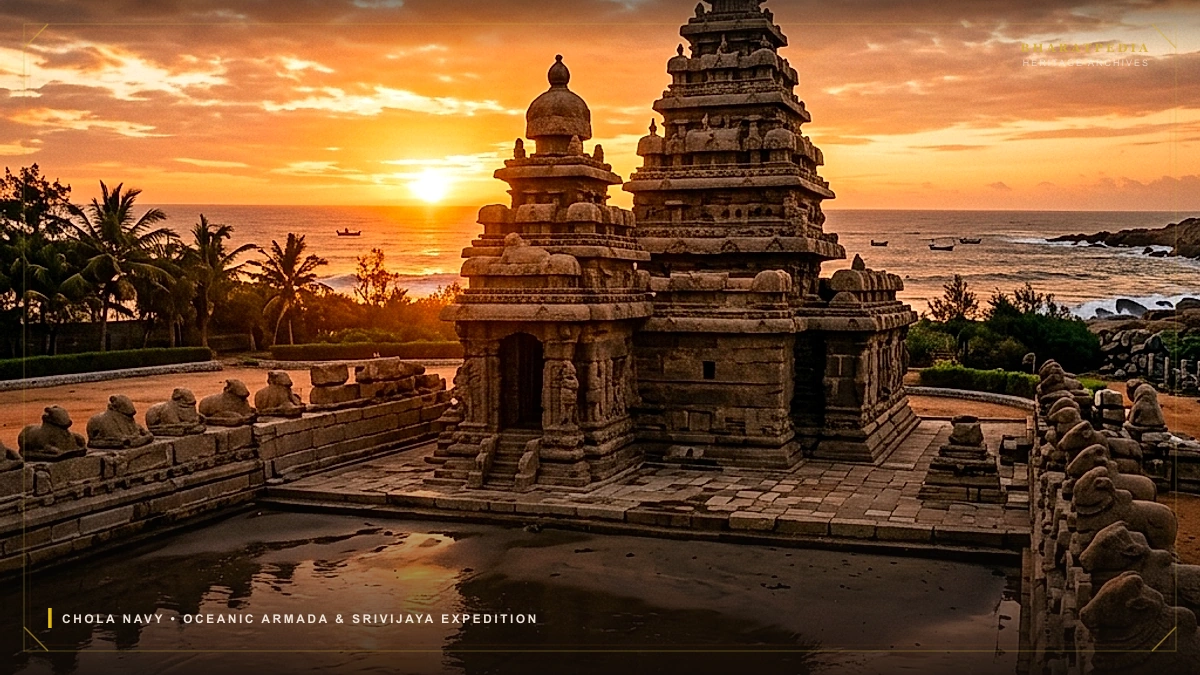
📜 Executive Heritage Snapshot
📍 Heritage Atlas & Geographic Location
🌟 UNESCO World HeritageIn the spring of 1025 CE, an armada of war vessels assembled along the Coromandel coast of Southern India. Tall masts bristled with crimson banners bearing the leaping tiger emblem of the Chola Dynasty. Heavy teak hulls creaked against the tides of Nagapattinam as thousands of armor-clad marine infantry, naval commanders, and veteran sailors boarded their ships. At the helm of this maritime power stood Emperor Rajendra Chola I—a sovereign whose military genius and geopolitical vision executed one of the most audacious naval campaigns in medieval world history.
Crossing more than 1,500 nautical miles of open sea across the Bay of Bengal—a body of water so completely dominated by Chola ships that contemporary chroniclers referred to it simply as the "Chola Lake"—the imperial fleet launched a surprise strike against the wealthy Srivijaya Empire in Southeast Asia. This was not a mere raid; it was a masterclass in strategic power projection, naval tactics, and economic statecraft that shattered a commercial monopoly, secured international trade routes, and permanently reshaped the cultural and economic landscape of Asia.
1. The Geopolitical Choke Point: Srivijaya's Monopoly
During the eleventh century, the Indian Ocean was the beating heart of global commerce connecting Song Dynasty China, the Buddhist and Hindu kingdoms of Southeast Asia, the Chola Empire, and the Abbasid Caliphate in Baghdad.
+-----------------------------------------------------------------------------------+
|                        MEDIEVAL MARITIME SILK ROAD (c. 1000 CE)                   |
+-----------------------------------------------------------------------------------+
|  [ Abbasid Caliphate ] <---> [ Chola Empire ] <---> [ Srivijaya ] <---> [ Song China ]  |
|     (Arabian Sea)           (Coromandel Coast)     (Strait of Malacca)  (South China Sea) |
+-----------------------------------------------------------------------------------+
Srivijaya (centered on Sumatra and controlling modern Malaysia and the Sunda Strait) held a strategic stranglehold over the narrow waters of the Strait of Malacca. To maximize imperial revenue, Srivijayan rulers began imposing exorbitant transit tariffs, impounding merchant cargoes, and threatening Tamil trading guilds—most notably the Ayyavole 500 (Ainurruvar), the Manigramam, and the Anjuvannam.
Furthermore, Srivijaya intercepted direct commercial embassies dispatched by Rajendra Chola to the Song court in Kaifeng. In response, Rajendra resolved to dismantle the monopoly through naval force.
2. Naval Architecture: The Warships of the Chola Armada
Chola naval architecture integrated indigenous Tamil boatbuilding traditions with hydraulic engineering:
- Dharani (Multi-Decked War Galley): Massive ocean-going flagships constructed of teak and poon wood, fitted with dual rudders, lateen sails, and multiple banks of oars to maneuver when monsoon winds slackened.
- Vanni & Padagu: Fast escort galleys carrying marine archers equipped with composite reflex bows and flaming pitch arrows.
- Marine Infantry (Kadaikootu Valaikkarar): Elite boarding troops trained in hand-to-hand combat using swords, spears, and iron-tipped throwing harpoons.
3. The 1025 CE Blitzkrieg Campaign
Utilizing the shifting southwest monsoon winds, Rajendra Chola launched a simultaneous, multi-pronged naval assault on Southeast Asian ports:
- Sack of Palembang: The fleet bypassed Srivijaya's forward outposts and sailed directly up the Musi River to strike the imperial capital of Palembang in Sumatra. The royal palace was taken, and King Sangrama-Vijayottungavarman was captured.
- Conquest of Kadaram (Kedah, Malaysia): The Chola fleet captured the heavily fortified coastal fortress of Kadaram, dismantling its defensive boom barriers.
- Capture of 14 Strategic Ports: The Thanjavur temple inscriptions explicitly enumerate the conquered ports: Pannai (East Sumatra), Malaiyur (Jambi), Mayirudingam (Malacca), Ilangasogam (Langkasuka), Mappappalam (Pegu, Myanmar), and Valaippanduru (Vietnam/Indochina coast).
4. Diplomatic & Cultural Aftermath
Unlike European colonial powers centuries later, the Cholas did not annex Southeast Asia as permanent territorial colonies:
- Restoration of Vassal Kings: Once Srivijaya's predatory tariffs were abolished and free navigation through the Strait of Malacca was guaranteed, Chola forces reinstated cooperative local rulers under tributary treaties.
- Direct Sino-Indian Trade: Chola merchant guilds established permanent commercial stations (vihara-pattinam) in Guangzhou and Quanzhou. Song dynasty annals record that Chola envoys received unprecedented imperial honors from Emperor Zhenzong.
- Cultural Syncretism: The campaign accelerated the diffusion of South Indian temple architecture, Sanskrit-Tamil epigraphy, and classical dance throughout Southeast Asia, evident in the temple art of Prambanan, Angkor Wat, and the Dieng Plateau.
5. UPSC GS-1 Examination Takeaways
- Thirumalai Inscription (1026 CE): The primary epigraphical source for the Srivijaya expedition, engraved on a boulder at Thirumalai in Polur taluk, Tamil Nadu.
- Chudamani Vihara: Buddhist monastery built at Nagapattinam by Srivijayan King Sri Mara Vijayottungavarman with land endowments granted by Rajaraja Chola I via the Larger Leiden Plates.
- Sungam Tavirtta Cholan: Title assumed by King Kulottunga Chola I after he formally abolished customs duties on overseas trade in 1070 CE.
- Tamil Inscriptions in Southeast Asia: Discovered at Lobu Tua (Sumatra, 1088 CE) and Takua Pa (Thailand, 9th century CE), proving active administrative presence of Tamil merchant guilds.
UPSC Civil Services Syllabus Correlation
This topic maps directly to General Studies Paper 1 (Indian Heritage and Culture, History). Aspirants should review the primary inscriptions, architectural elevation (Vimana/Shikhara), and socio-economic governance models cited above.
Access Full UPSC GS-1 Art & Culture Syllabus Index →Curated by researchers in Indian archaeology, epigraphy, and military history. Grounded in ASI excavation papers, Epigraphia Indica, and primary numismatics.
Related Civilizational Explorations
The Maratha Navy & Sarkhel Kanhoji Angre: Asymmetric Littoral Warfare in the Arabian Sea
How Grand Admiral Sarkhel Kanhoji Angre defended the Konkan coast for 40 years: indigenous Gurab and Galbat war vessels, impregnable island forts like Vijaydurg and Sindhudurg, and asymmetric naval tactics against British, Dutch, and Portuguese armadas.
Lothal's Tidal Dockyard: Ancient Harappan Hydraulic Naval Engineering (2400 BCE)
The world's oldest engineered tidal dry dock: excavated at Lothal in Gujarat, this 214-meter burnt-brick basin utilized vertical wooden sluice gates and tidal currents to berth ocean-going vessels trading with Mesopotamia and Dilmun.
Rani of Jhansi: Complete History & Leadership in the 1857 Revolt
The heroic history of Rani Lakshmibai of Jhansi: her resistance to Lord Dalhousie's Doctrine of Lapse, the siege and defense of Jhansi Fort, the tactical escape to Kalpi and Gwalior, and her martyrdom at Kotah-ki-Serai in the 1857 War of Independence.