
The Maratha Navy & Sarkhel Kanhoji Angre: Asymmetric Littoral Warfare in the Arabian Sea
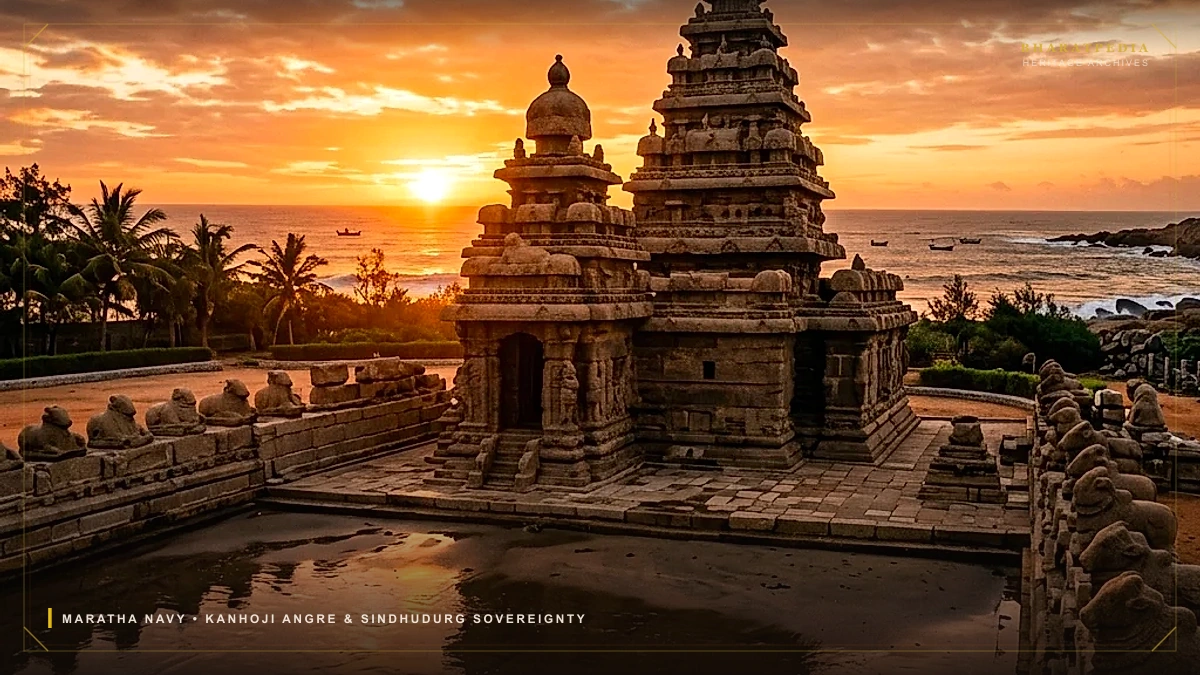
📜 Executive Heritage Snapshot
📍 Heritage Atlas & Geographic Location
📜 Civilizational MilestoneEstablished by Chhatrapati Shivaji Maharaj in 1659 ("He who rules the sea rules the land" — Ramchandra Pant Amatya in the Adnyapatra) and commanded to its legendary zenith by Grand Admiral Sarkhel Kanhoji Angre (1669–1729), the Maratha Navy dominated the Konkan coastline of the Arabian Sea for four decades.
Operating from impregnable coastal island fortresses (Sindhudurg, Vijaydurg, Suvarnadurg, Khanderi) and utilizing light, shallow-draft oared-and-sailed Gurabs (Grabs) and Galbats (Gallivats), Angre executed brilliant asymmetric littoral warfare, defeating multiple joint European fleets (British East India Company, Portuguese Royal Armadas, and Dutch squadrons) while asserting Maratha maritime sovereignty through the mandatory Dastak (naval transit permit) system.
1. Strategic Vision: Shivaji Maharaj's Naval Doctrine
Chhatrapati Shivaji Maharaj recognized that foreign powers—the British at Bombay, Portuguese at Goa, and Siddis of Janjira—derived their leverage from oceanic naval dominance.
In the royal administrative manual Adnyapatra, Shivaji's naval doctrine was codified:
- Sea Forts as Anchors of Sovereignty: Fortresses built directly on rocky marine outcrops (Sindhudurg, Padmadurg, Khanderi-Underi, Vijaydurg) protected naval shipyards, dry docks, and gun foundries.
- Indigenous Naval Architecture: Rejecting heavy, deep-draft European multi-deck galleons that ran aground in shallow estuaries, Shivaji commissioned indigenous shipwrights to craft nimble, double-masted shallow-draft vessels designed specifically for the jagged reefs and tidal creeks of the Konkan coast.
2. Warship Typologies: Gurabs and Galbats
| Vessel Class | Displacement & Crew | Armament | Tactical Function |
|---|---|---|---|
| Gurab (Grab) | 150 to 300 Tonnes; 150 marines | 16 to 22 Cannons (9 to 12 pounders) | Heavy flagship; low broadside, high prow; mounts forward-chase guns firing straight ahead into enemy sterns. |
| Galbat (Gallivat) | 50 to 120 Tonnes; 60–80 oarsmen | 6 to 10 Swivel Guns (Jazails) | Fast attack oared galley; rows up to 8 knots in dead calm; boards enemy vessels after main rigging is shredded. |
| Machva & Pal | 30 to 80 Tonnes | 2 to 4 Light Cannons | Fast coastal reconnaissance, resupply, and communications. |
3. Asymmetric Naval Tactics in Action
Kanhoji Angre never engaged European ships-of-the-line in open, deep-water artillery duels. Instead, he exploited wind and hydrography:
- Exploitation of the Morning Land Breeze: During morning hours when wind died down and heavy European square-rigged ships lay dead in the water, Maratha Galbats deployed 40 to 60 oars, towing heavier Gurabs into firing positions off the defenseless sterns and bows of British warships.
- Submerged Defensive Reefs: At Vijaydurg Fort, Maratha engineers constructed an underwater stone wall (tetrahedron masonry reef) 100 meters off the coast, submerged 3 meters beneath the water line. When pursuing British ships chased Maratha vessels into the bay, British keels struck the submerged wall and broke apart, while shallow-draft Maratha Gurabs passed safely over the barrier.
- Stern Raking Fire & Boarding Action: Maratha gunners concentrated fire on the steering rudder and main masts, immobilizing the ship before boarding parties armed with swords, shields, and composite bows overwhelmed the enemy crew.
4. Defeat of the Anglo-Portuguese Coalitions
Between 1718 and 1722, European powers launched repeated punitive expeditions against Angre's strongholds:
- British Siege of Khanderi (1718): Governor Charles Boone dispatched a fleet under Commodore Matthews to seize Khanderi Island off Mumbai. Angre's shore batteries repulsed three amphibious landing attempts with heavy British casualties.
- Joint Anglo-Portuguese Armada at Vijaydurg (1721): A combined force of four British warships, three Portuguese galleons, and 6,000 soldiers attacked Vijaydurg. Angre counter-attacked simultaneously from land batteries and sea vessels, burning the British flagship and forcing an ignominious retreat.
Until his death in 1729, Sarkhel Kanhoji Angre remained completely undefeated at sea.
5. UPSC GS-1 Examination Takeaways
- Adnyapatra: 17th-century administrative treatise written by Ramchandra Pant Amatya; contains the foundational chapter on Maratha naval warfare and fort construction.
- Sarkhel: The official Maratha naval rank equivalent to Grand Admiral of the Fleet.
- Sindhudurg Fort: Marine fortress built on Kurte island off Malvan in 1664; Shivaji personally laid its foundation stone, utilizing over 4,000 pounds of molten lead for the granite footings.
- Modern Navy Emblem: The modern Indian Navy crest, unveiled in 2022, draws directly from the royal seal (Rajmudra) of Chhatrapati Shivaji Maharaj, honoring his status as the Father of the Indian Navy.
UPSC Civil Services Syllabus Correlation
This topic maps directly to General Studies Paper 1 (Indian Heritage and Culture, History). Aspirants should review the primary inscriptions, architectural elevation (Vimana/Shikhara), and socio-economic governance models cited above.
Access Full UPSC GS-1 Art & Culture Syllabus Index →Curated by researchers in Indian archaeology, epigraphy, and military history. Grounded in ASI excavation papers, Epigraphia Indica, and primary numismatics.
Related Civilizational Explorations
The Chola Navy & Maritime Imperium: Rajendra Chola's Southeast Asian Campaign (1025 CE)
How Rajendra Chola I built a high-seas armada of war galleons, traversed 1,500 nautical miles across the Bay of Bengal, conquered fourteen ports of the Srivijaya Empire in Sumatra and Malaya, and secured the Maritime Silk Road.
Lothal's Tidal Dockyard: Ancient Harappan Hydraulic Naval Engineering (2400 BCE)
The world's oldest engineered tidal dry dock: excavated at Lothal in Gujarat, this 214-meter burnt-brick basin utilized vertical wooden sluice gates and tidal currents to berth ocean-going vessels trading with Mesopotamia and Dilmun.
Rani of Jhansi: Complete History & Leadership in the 1857 Revolt
The heroic history of Rani Lakshmibai of Jhansi: her resistance to Lord Dalhousie's Doctrine of Lapse, the siege and defense of Jhansi Fort, the tactical escape to Kalpi and Gwalior, and her martyrdom at Kotah-ki-Serai in the 1857 War of Independence.