
Maratha Empire: Timeline, Rulers, Ganimi Kava & Civilizational Legacy
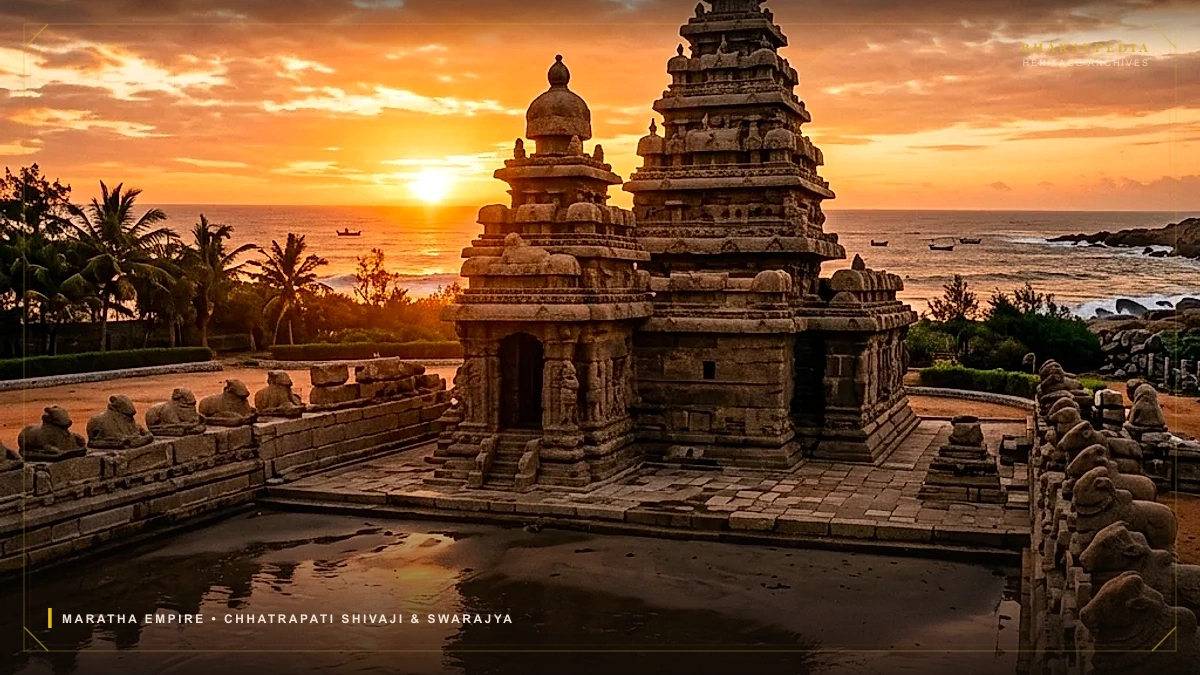
📜 Executive Heritage Snapshot
📍 Heritage Atlas & Geographic Location
📜 Civilizational MilestoneThe rise of the Maratha Empire in the seventeenth century dramatically transformed the geopolitical trajectory of the Indian subcontinent. Emerging from the rugged, basalt-strewn highlands of the Western Ghats (Sahyadri), Chhatrapati Shivaji Maharaj forged an indigenous sovereign state—Hindavi Swarajya—that challenged both the established Mughal Empire in Delhi and the Adil Shahi Sultanate of Bijapur.
Over the succeeding century, Maratha power transformed from a regional mountain kingdom into a continental confederacy that collected tribute from the banks of the Indus in Attock to the delta of the Kaveri in Thanjavur, becoming the paramount sovereign power in India prior to the British East India Company’s colonial expansion.
1. Chronological Horizon: Key Historical Epochs
| Epoch | Dates | Defining Characteristics | Key Figures |
|---|---|---|---|
| Shivaji’s Swarajya Foundation | 1645 – 1680 CE | Capture of Torna, Pratapgad; Afzal Khan campaign; coronation at Raigad (1674); Southern campaign (Dakshin Digvijaya). | Chhatrapati Shivaji Maharaj, Jijabai |
| The War of Independence | 1681 – 1707 CE | 27-year war of exhaustion against Mughal Emperor Aurangzeb; martyrdom of Sambhaji; mobile resistance led by Rajaram and Tarabai. | Chhatrapati Sambhaji, Maharani Tarabai, Santaji Ghorpade, Dhanaji Jadhav |
| Peshwa Imperial Expansion | 1713 – 1761 CE | Shift of administrative power to Pune; Peshwa Baji Rao I drives northward across Narmada; capture of Malwa, Gujarat, Bundelkhand; apex at Delhi and Attock. | Peshwa Balaji Vishwanath, Peshwa Baji Rao I, Balaji Baji Rao (Nana Saheb) |
| Panipat Crisis & Reconstruction | 1761 – 1795 CE | Catastrophic tactical defeat at Third Battle of Panipat (1761); resurrection of Maratha influence in North India by Mahadji Scindia and Nana Fadnavis. | Mahadji Scindia, Nana Fadnavis, Ahilyabai Holkar |
| The Confederacy & Anglo-Maratha Wars | 1775 – 1818 CE | Internal factional rivalries between Gwalior, Indore, Nagpur, and Baroda; Three Anglo-Maratha Wars culminating in British annexation in 1818. | Yashwantrao Holkar, Daulat Rao Scindia, Peshwa Baji Rao II |
2. Military Innovation: The Doctrine of Ganimi Kava
The foundational military genius of Shivaji Maharaj lay in recognizing that a conventional, heavily encumbered standing army could never defeat the numerically superior artillery and heavy cavalry of imperial Mughal forces in open plains. In response, he refined Ganimi Kava—a sophisticated doctrine of asymmetric, highly mobile mountain warfare:
- Light Cavalry Mobility (Bargirs and Shiledars): Maratha cavalry carried minimum baggage, relying on local saddle-bags of parched gram and dried rotis, enabling swift movements of 60 to 80 kilometers per day over steep mountain trails.
- Terrain Asymmetry: Enticing enemy forces into narrow mountain passes (such as the Battle of Umberkhind, 1661) where artillery could not deploy, followed by sudden, simultaneous ambushes from ridges.
- Network of Hill & Sea Forts: Shivaji constructed or repaired over 300 stone forts. Forts like Raigad, Pratapgad, Torna, and Rajgad functioned as impregnable command posts, food depots, and refuge bases. On the coastline, marine citadels like Sindhudurg and Vijaydurg housed the fledgling Maratha Navy.
3. Administrative Genius: The Ashta Pradhan Council
Shivaji’s governance model was remarkably progressive for its era, rejecting personal whims in favor of a codified institutional council of eight ministers known as the Ashta Pradhan:
| Title | Sanskrit Designation | Ministerial Portfolio |
|---|---|---|
| Peshwa | Mukhya Pradhan | Prime Minister; general administration and royal deputy |
| Amatya | Majumdar | Finance Minister; accounts, taxation, and treasury |
| Sachiv | Shurunavis | Home Secretary; imperial royal edicts and correspondence |
| Mantri | Waqia-Navis | Interior Minister; intelligence, record-keeper, court affairs |
| Senapati | Sari-Naubat | Commander-in-Chief of the Army |
| Sumant | Dabir | Foreign Minister; external alliances and ambassadorial diplomacy |
| Nyayadhish | Chief Justice | Judiciary and civil/criminal legal disputes |
| Panditrao | Dhanadhyaksha | Religious affairs, charitable endowments, and cultural patronage |
Administrative Innovation: Shivaji explicitly decreed that ministerial positions would not be hereditary. Furthermore, ministers were paid fixed cash salaries (nakad) from the state treasury rather than being granted hereditary feudal estates (jagirs), eliminating independent feudal power bases.
4. The Revenue Architecture: Chauth and Sardeshmukhi
To fund the standing army without overburdening his home peasantry, the Maratha state operated a dual-tier fiscal structure:
Swarajya Territory: The Kathi System
Within sovereign territories, Shivaji abolished the arbitrary zamindari system of revenue collection, measuring land using a standardized rod (Shivaji Kathi). The state assessed land according to soil fertility, claiming two-fifths (40%) of agricultural produce while providing state seed loans (tagai) to farmers during droughts.
External Protection Taxes: Chauth & Sardeshmukhi
In territories outside the core Swarajya realm:
- Chauth (25%): One-fourth of the assessed land revenue collected from neighboring provinces in return for Maratha protection against third-party raids.
- Sardeshmukhi (10%): An additional ten percent levy claimed by Shivaji by hereditary right as the supreme head (Sar-Deshmukh) of all Deshmukhs across Maharashtra.
5. The Peshwa Expansion: Northern Hegemony Under Baji Rao I
Following the death of Emperor Aurangzeb in 1707 and the return of Shivaji’s grandson Chhatrapati Shahu, administrative authority transitioned into the hands of the hereditary Prime Ministers (the Peshwas) based at Shaniwar Wada in Pune.
Under Peshwa Baji Rao I (1720–1740), the Maratha cavalry shifted from defensive mountain warfare to lightning campaigns across Central and Northern India. Proclaiming the famous strategy:
"Let us strike at the trunk of the withering tree, and the branches will fall off themselves. Thus should the Maratha flag fly from the Krishna to the Indus."
Key Battles of Peshwa Baji Rao I
- Battle of Palkhed (1728): A masterpiece of strategic maneuver without artillery, where Baji Rao surrounded the Nizam of Hyderabad and cut off his water supply, forcing total capitulation.
- Battle of Bhopal (1737): Decisive encirclement of combined Mughal and Nizam forces, granting the Marathas formal territorial cession of Malwa and the land between the Narmada and Chambal.
- Dash to Delhi (1737): A rapid 10-day cavalry march that appeared outside the gates of Delhi, paralyzing the imperial court.
6. The Third Battle of Panipat (1761) & The Confederacy
On January 14, 1761, the northern Maratha army under Sadashivrao Bhau met the Afghan forces of Ahmad Shah Abdali (Durrani) on the historic battlefield of Panipat in Haryana.
Strategic Causes of Defeat
- Diplomatic Isolation: Maratha regional levies alienated regional Rajput rulers, while the Nawab of Awadh (Shuja-ud-Daula) and the Rohilla Afghans joined Abdali.
- Logistical Starvation: Abdali’s forces severed the Maratha communication and food supply line back to Delhi, forcing Sadashivrao Bhau to fight under conditions of acute hunger.
- Artillery Innovation: Abdali deployed 2,000 zamburaks (swivel-mounted light cannons on camel backs) that out-maneuvered the heavy, static French-style artillery commanded by Ibrahim Khan Gardi.
The Rise of the Maratha Confederacy
While Panipat claimed 40,000 elite Maratha veterans, the empire quickly rebounded under the genius of Mahadji Scindia, who modernized his battalions with European flintlocks and restored Emperor Shah Alam II to the throne in Delhi in 1771 under Maratha regency. The empire subsequently functioned as a decentralized confederacy:
- Scindias (Shindes): Gwalior (Northern India & Delhi)
- Holkars: Indore & Malwa (patronized by Queen Ahilyabai Holkar)
- Gaekwads: Baroda (Gujarat)
- Bhonsles: Nagpur (Central & Eastern India, extending to Odisha)
- Peshwas: Pune (Deccan core)
7. UPSC GS-1 Examination Master Key
High-Yield Prelims Pointers
- Coronation of Shivaji: 1674 CE at Raigad by Pandit Gaga Bhatt of Varanasi; assumed the titles Chhatrapati and Haindava Dharmoddharak.
- The Maratha Navy: Organized under Admiral Kanhoji Angre, based at Vijaydurg and Kolaba; successfully held off Portuguese, Dutch, and English fleets for decades.
- Treaty of Purandar (1665): Signed between Shivaji and Raja Jai Singh of Amber; Shivaji surrendered 23 of his 35 forts to Aurangzeb before his dramatic visit to Agra.
- Treaty of Salbai (1782): Concluded the First Anglo-Maratha War, securing 20 years of peace orchestrated by Mahadji Scindia and Warren Hastings.
Mains Analytical Discussion Framework
Question: "Evaluate the factors that enabled the Marathas to emerge as the paramount power in 18th-century India, and analyze why they ultimately failed to establish a durable pan-Indian central government."
Structure your answer around:
- Strengths: Mobile military tactics (Ganimi Kava), progressive civic-revenue reforms (Ashta Pradhan, abolition of hereditary jagirs), geographic defensive fort chain.
- Institutional Weaknesses: Failure to replace the Mughal imperial taxation apparatus with sustainable domestic industrialization; heavy reliance on Chauth collections created deep hostility among neighboring regional kingdoms.
- Confederate Fragmentation: The rise of autonomous military houses (Scindia vs. Holkar) without unified diplomatic discipline allowed the British East India Company to divide and conquer during the Second and Third Anglo-Maratha Wars.
UPSC Civil Services Syllabus Correlation
This topic maps directly to General Studies Paper 1 (Indian Heritage and Culture, History). Aspirants should review the primary inscriptions, architectural elevation (Vimana/Shikhara), and socio-economic governance models cited above.
Access Full UPSC GS-1 Art & Culture Syllabus Index →Curated by researchers in Indian archaeology, epigraphy, and military history. Grounded in ASI excavation papers, Epigraphia Indica, and primary numismatics.
Related Civilizational Explorations
Chola Dynasty: Architecture, Naval Dominance & Cultural Empire
The epic saga of the Imperial Cholas: Rajaraja I's Brihadeeswarar Temple engineering, Rajendra I's naval conquest of Srivijaya, bronze Nataraja casting, the Uttaramerur democratic inscriptions, and India's maritime golden age.
Rani of Jhansi: Complete History & Leadership in the 1857 Revolt
The heroic history of Rani Lakshmibai of Jhansi: her resistance to Lord Dalhousie's Doctrine of Lapse, the siege and defense of Jhansi Fort, the tactical escape to Kalpi and Gwalior, and her martyrdom at Kotah-ki-Serai in the 1857 War of Independence.
The Maratha Navy & Sarkhel Kanhoji Angre: Asymmetric Littoral Warfare in the Arabian Sea
How Grand Admiral Sarkhel Kanhoji Angre defended the Konkan coast for 40 years: indigenous Gurab and Galbat war vessels, impregnable island forts like Vijaydurg and Sindhudurg, and asymmetric naval tactics against British, Dutch, and Portuguese armadas.