
Konark Sun Temple: The Black Pagoda & Kalinga Astronomical Architecture
📜 Executive Heritage Snapshot
📍 Heritage Atlas & Geographic Location
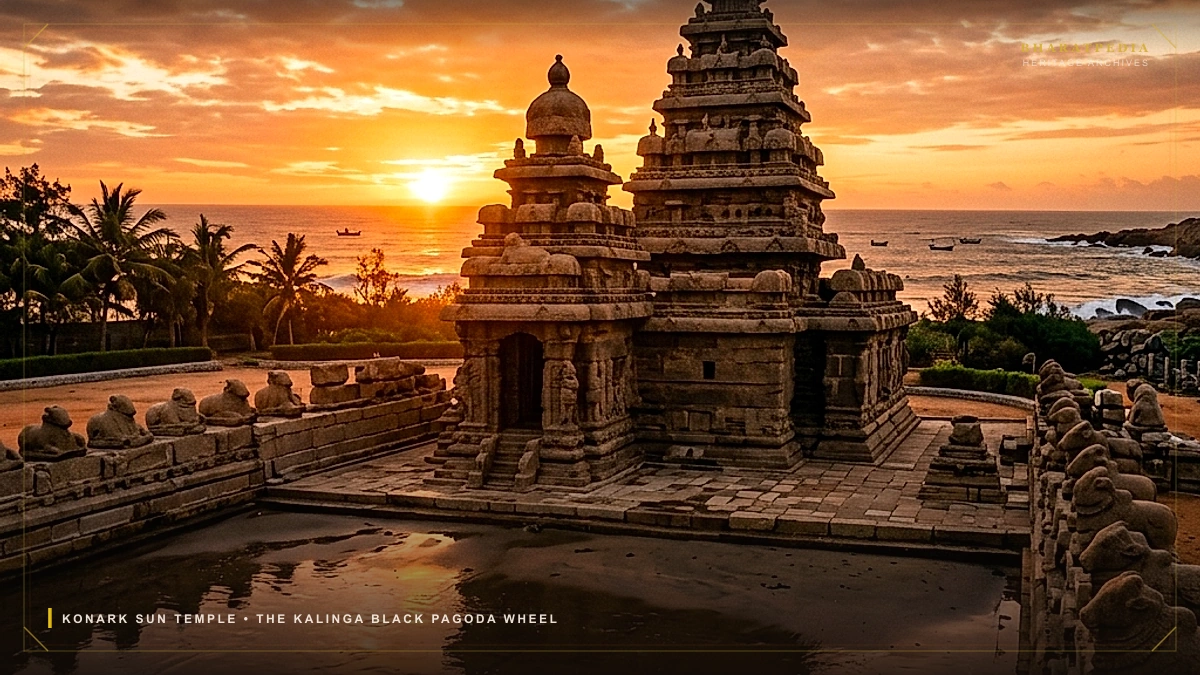
🌟 UNESCO World HeritagePerched along the Bay of Bengal coastline in Odisha, the thirteenth-century Sun Temple of Konark represents the grand architectural climax of the Kalinga temple tradition. Commissioned around 1250 CE by King Narasimhadeva I of the Eastern Ganga Dynasty to commemorate his military triumphs over regional Sultanates, the temple was conceptualized as a monumental stone chariot (Ratha) carrying Surya, the Sun God, across the cosmic skies.
Crafted from dark ferruginous sandstone and green chlorite stone, European sailors navigating the Bay of Bengal dubbed Konark the "Black Pagoda" due to its dark stone silhouette serving as a vital navigational landmark, contrasting with the whitewashed spires of the Jagannath Temple at Puri (the "White Pagoda").
1. Architectural Anatomy: The Kalinga Deula Style
Kalinga architecture is divided into three distinct spatial structures, all executed to colossal scale at Konark:
[Natamandapa (Dance Pavilion)] ──► [Jagamohana (Audience Hall)] ──► [Rekha Deula (Tower)]
     (Hypostyle Pillar Hall)               (Stepped Pyramidal Roof)             (Curvilinear Spire - 70m)
- The Rekha Deula (Main Sanctum Tower): Originally rose to a towering height of 70 meters (229 feet). Though the soaring main shikhara collapsed in the 17th century due to foundation shifting and saline coastal weathering, its colossal plinth remains intact.
- The Jagamohana (Porch / Audience Hall): The surviving stepped pyramidal structure rising 39 meters (128 feet) above the coastal plain. In the early 20th century, British archaeological engineers packed the interior with sand and masonry to prevent structural collapse.
- The Natamandapa (Festival Dance Hall): An elevated open pavilion set with 64 intricately carved pillars depicting musicians playing the mridangam, cymbals, flutes, and dancers frozen in classical Odissi postures.
2. The 24 Sundial Wheels: Astronomical Chronometry
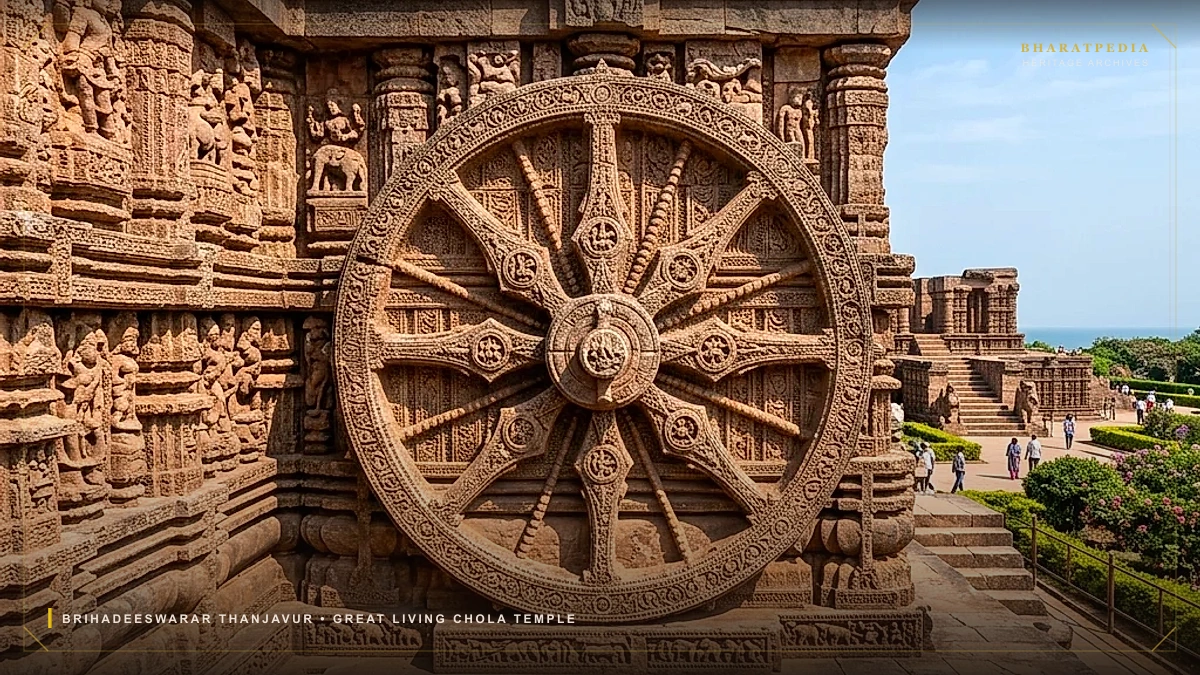
The most celebrated innovation of Konark is its base platform, mounted upon 24 intricately carved stone wheels, each measuring nearly 3 meters (9.9 feet) in diameter, pulled by a team of seven rearing stone horses symbolizing the days of the week:
- The 24 Wheels: Represent the 24 fortnights (Pakshas) of the Hindu lunar-solar calendar year.
- The Spoke Configuration: Each wheel features eight wide major spokes and eight slender minor spokes, dividing the 24-hour cycle into eight 3-hour watches (prahars).
- Minute-Level Precision: By observing the exact shadow cast by the central axle pin against the carved bead friezes along the outer rim, ancient observers could tell the exact time of day down to the minute.
- The 10-Rupee Banknote: The Reserve Bank of India prominently features the Konark wheel on the reverse of the ₹10 currency note, celebrating Indian scientific and artistic heritage.
3. Sculptural Vibrancy & Material Mastery
Konark's exterior surface is adorned with thousands of relief sculptures depicting the full spectrum of medieval Indian life:
- Military Processions: Royal cavalry, war elephants wearing chain mail, archers with longbows, and infantry with curved swords.
- Mithuna Panels: Sensuous erotic sculptures celebrating vital cosmic energy (Kama) alongside spiritual dharma and worldly duty (Artha).
- Green Chlorite Icons of Surya: Three life-sized statues of Surya carved from exceptionally fine green chlorite stone remain inside the niches, capturing the dawn sun (Usha), midday sun (Madhyanha), and evening sunset (Sandhya).
4. UPSC GS-1 Examination Takeaways
- Patron Dynasty: Eastern Ganga Dynasty (King Narasimhadeva I, who ruled 1238–1264 CE).
- Master Architect: According to regional Odia tradition, the chief architect was Bisu Maharana, whose twelve-year-old son Dharmapada sacrificed his life by leaping from the crowning capstone into the sea to save the stonemasons' guild from royal execution.
- UNESCO World Heritage Inscription: Declared a World Heritage Site in 1984.
- Iron Clamps & Lodestones: Early records suggest the temple utilized heavy iron beams (dhamnis) and magnetic lodestones within the masonry to stabilize the soaring corbelled stonework.
UPSC Civil Services Syllabus Correlation
This topic maps directly to General Studies Paper 1 (Indian Heritage and Culture, History). Aspirants should review the primary inscriptions, architectural elevation (Vimana/Shikhara), and socio-economic governance models cited above.
Access Full UPSC GS-1 Art & Culture Syllabus Index →Curated by researchers in Indian archaeology, epigraphy, and military history. Grounded in ASI excavation papers, Epigraphia Indica, and primary numismatics.
Related Civilizational Explorations
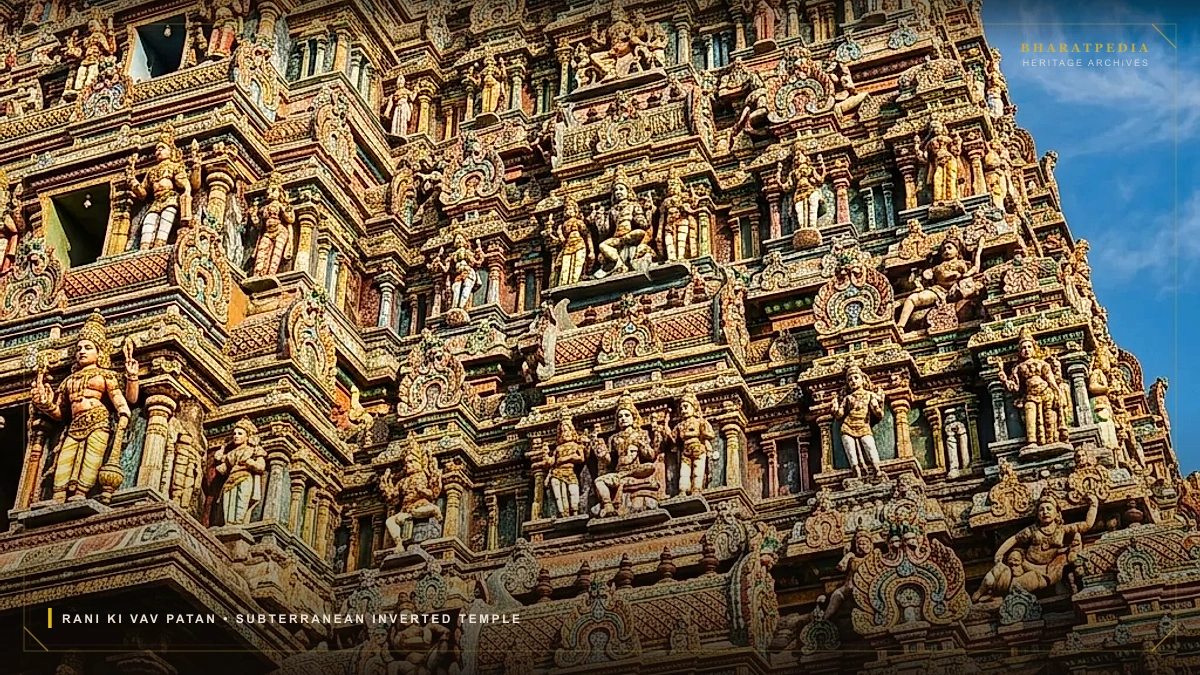
Rani Ki Vav at Patan: The Subterranean Inverted Temple of Gujarat
The subterranean masterwork of Rani Ki Vav in Patan, Gujarat: Queen Udayamati's 11th-century stepwell, designed as an inverted temple descending seven tiers into the earth, with over 500 sculptures of Vishnu's Dashavatara.
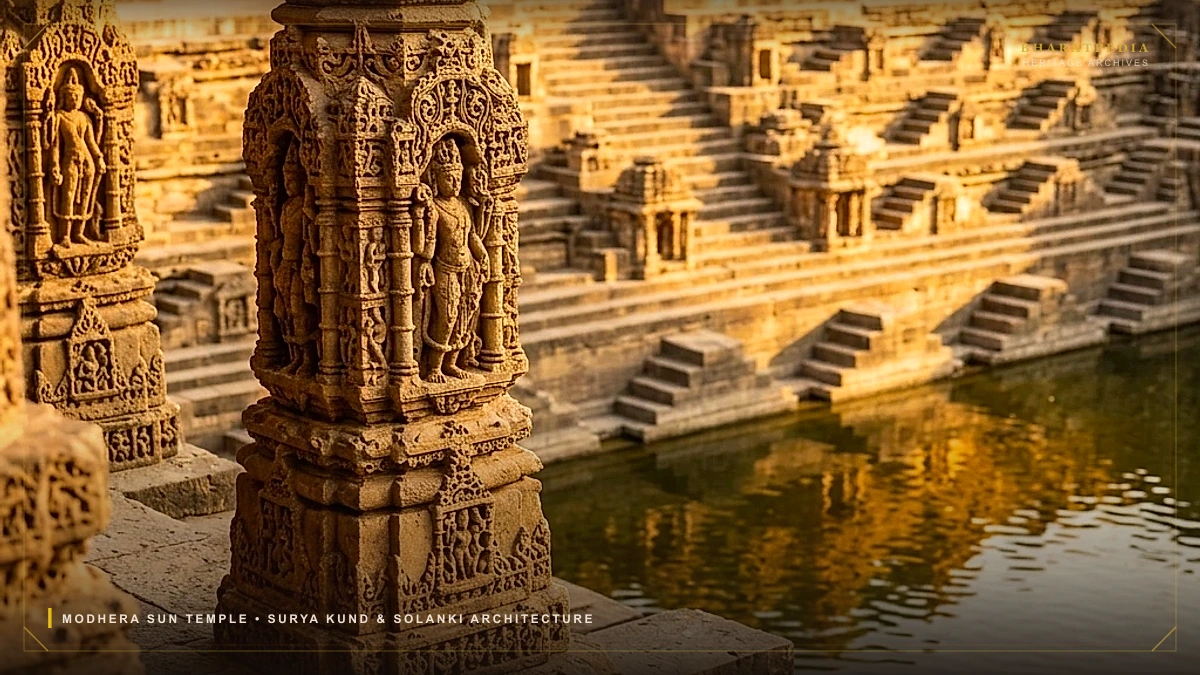
Modhera Sun Temple: Solanki Architectural Geometry & Solar Equinox Alignment
The sacred geometry of the Sun Temple at Modhera: King Bhima I's Maru-Gurjara masterpiece, the 52 carved pillars of the Sabha Mandapa, the stepped Surya Kunda tank, and the optical equinox alignment where rising sunbeams illuminate the sanctum.
Brihadeeswarar Temple of Thanjavur: The Granite Titan of Chola Architecture
The engineering triumph of the Peruvudaiyar Kovil at Thanjavur: Rajaraja Chola's 66-meter mortarless granite vimana, the 81-tonne monolithic capstone hoisted via a 6 km earthen ramp, and 1,000 years of living Shaivite worship.